

Showing posts with label Mysterious Occurrences. Show all posts
Showing posts with label Mysterious Occurrences. Show all posts
Saturday, January 18, 2014
A Diabolical Pact
Here, courtesy of Wikipedia, is a page written in backwards Latin, supposedly codifying the agreement between Catholic Priest Urbain Grandier and a whole bunch of Demons, including Lucifer, Satan, Astaroth, and a few others. Apparently, in exchange for his soul, Grandier would become completely irresistible to women, would have the friendship of the rich and powerful, and would himself receive more than his fair share of worldly power and pleasure. This document was used as evidence for Grandier's diabolical powers in his trial, eventually sending him to be burned at the stake.

Thursday, October 24, 2013
Une Geographie Infernale - Gedsbry Abbey, Northumberland, England
From its rough perch on The Giant’s Hill, the tumbledown ruin of Gedsbry Abbey frowns down over the River Coquet, a reminder of old days and ancient practices long forgotten. The Poor Brothers of St. Christopher settled in the rough hill country of Northumberland sometime in the late 1090’s or early 1100’s, though the specific c date of their arrival is uncertain. We do see their Monastery included in the accounting of Sheri ff Odard for the Great Roll of the Exchequer in 1131, allowing us to place them roughly in the early 12th Century. The land, including the famously haunted hill upon which the Brothers built their monastery, was granted them by the King. Perhaps the Norman conquerors hoped that the famously rebellious people of Northumber country would be calmed by the presence of God-fearing monks? Unasked at the time, however, was the question of which “God”, exactly, the Poor Brothers feared?

The Brothers venerated Saint Christopher who, among other things, was the patron saint of epilepsy, a malady long associated with prophecy and occult vision. Apparently they got something out of the deal, since the Brothers soon gained a reputation for divining the future with unusual accuracy. One Brother Oswulf, noted for his prognosticatory abilities, was said to have prophesized the calamitous storm of 1192 that collapsed the roof of a local lord’s hall, killing everyone within. The unfortunate Lord’s land was quickly
bought up by the Abbey. Similarly, an Abbot Martin accurately foretold of the catastrophic fl ooding of the Tyne in the spring of 1215. This warning was ignored by the people of adjacent villages, who subsequently suffered great loss of life and property while the Brothers, having moved their fl ocks to higher ground, enjoyed something of a monopoly on wool and mutton for many years after. Soon, commoners and potentates alike would travel to the Abbey, seeking an audience with its mystical Monks that saw the future in strange trances. Thus, while bereft of the relics normally associated with a wealthy abbey, the Brothers of Gedsbry did a brisk enough trade in fortune-telling to buy up numerous properties up and down the valley.
Rumors of the source of these visions all seemed to point to a distinctly non-Chrisitian origin, however. The Giant’s Hill, upon which the abbey is built, has had a long history of haunting and mysterious events. These began with the first Roman chronicles from the area, who noticed that the site was of particular abhorrence to the native Celts known as the Votadini. One Severus Magnus, a Legionnaire of equestrian rank, wrote of the mysterious rites of the Picts who, slipping across the border on moonless nights, would hold unholy sacrifices atop a place he termed the “domum gigantes”. Here, he wrote, their wild chants would be answered by terrible voices coming up from the ground that, in exchange for blood, instructed pictish shamans in all the secrets of the earth.
The retreat of Rome and the advent of the Dark Ages did little to lessen the weirdness of the locale. The Anglian Kingdom of Northumbria, dominant in the 7th and 8th Centuries, left many chilling tales that found their way into the libraries of many monasteries. The most famous tells of the hellish vision of a young man named Oswiu. Lost and wandering in the dark, he came upon a hill lit with unholy flame and circled round by a horned serpent that whispered blasphemies to the stars. Tending the fire atop the hill was a giant man blue with woad and girt with wolfskin, while naked celebrants danced and writhed in the relight. Among the more human celebrants, Oswiu is said to have recognized neighbors and prominent land-owners. He fled the scene, and reported all to the King. In the subsequent weeks, many people were rounded up by King Ceolwulf and drowned in the North Sea for the “grievous sins” of sorcery, necromancy, false prophecy, and paganism. Shortly thereafter Ceolwulf himself, perhaps hounded by the horrors he had heard and witnessed at the trials, abdicated the throne and retired to a monastery for the rest of his days.
By the time the Poor Brothers of Saint Christopher came on the scene then, we see that the Giant’s Hill had already become a grisly haunt of ghosts and goblins. Why then did these strange Monks from the continent settle there? Some scholars believe that their choice was not in spite of these rumors, but rather because of them. Although the record is muddled, it appears that the Brothers were not entirely naïve about occult topics, for in all the pertinent records we fi nd the Poor Brothers wrapped in a cloak of mysticism and
rumored diabolism. For starters, whence came the Poor Brothers? By their own accounts, they had fled persecution “in the east”, and that their order was originally from the first missions sent to Egypt, perhaps making them Coptic. What secrets had they learned in that ancient land?
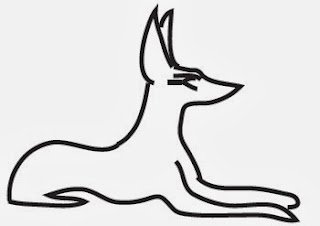
This Egyptian connection is important, and it may be that the Brothers had already tipped their hand. As noted above, the Brothers of Gedsbry Abbey had a special enthusiasm for Saint Christopher. In some traditions, St. Christopher was said to have been one of the cynocephali, strange creatures mentioned by Herotodus and Ctesias in the Ancient World, and by Paul the Deacon in his “Historia gentis Langobardorum” in the Middle Ages. Specifically, St. Christopher was believed by some to have had the head of a dog. A dog-headed figure associated with holy death and mystic visions? A similarly figure is found among the Egyptians in the form of the most occult Anubis, the ancient dog-headed God of the Dead.

It is recorded that, when the Poor Brothers of St. Christopher traveled up the River Coquet to their new home, they carried with them an icon or statue of their Saint in the form of a robed, dog-headed man. Beyond this similar iconography, there is an additional piece of evidence linking the Poor Brothers of St. Christopher to Egyptian mysticism and the Cult of Anubis: mummies.
Anubis, in his role as the God of Death, was often portrayed by the Egyptians as an embalmer. It was Anubis who gave the Egyptians the art of preserving and protecting the bodies of the dead, a central component Egyptian religion. Northumberland is, of course, far to damp a place for traditional mummi fication. However, though it lacks the dry wind and sand of the African deserts, the north of England is rich in peat bogs, which are just as capable of working the magic of mummification on the remains of mortal men and women. Buried deep in the acidic muck of the bogs, the bodies of the dead are cured and the soft tissues preserved with an excellence that would arouse the envy of a Pharaoh. Skin, hair, cloth, all well preserved, though of course the bones of the dead quickly dissolve away, leaving a distorted and disturbingly sack-like bog mummy behind.
These mummies are common in Northumberland, associated with both the Celtic and Norse settlements of Late Antiquity and the early Dark Ages. Internment in the bogs was of a clearly ceremonial nature, the individuals having been fed a final meal of bread baked with ash before being ritualistically killed via strangulation or, less commonly, bludgeoning. The mummies are also often found in association with offerings of iron weapons or tools, an extravagant waste of rare metal that speaks to the importance of these bog burials. Christianization of the North resulted in a marked change in burial practices, of course; after the sixth or seventh century C.E., one does not find bog mummies.
Except…there is a period where bog mummies become common again, temporally and spatially coinciding precisely with activity at Gedsby Abbey. Beginning in the mid 1100s, and continuing on until approximately the late 1300s, bodies were being inhumed in the swamps five miles north of The Giant’s Hill. These remains, their bellies stuff ed with ash-laden bread, limbs bound, and throats slashed, are often found with small iron statues of a dog-headed man. It is a remarkably consistent return to form after many hundreds of years without, apparently, any intervening continuity.
In 1244 C.E., a combined secular and ecclesiastical enclave was convened to address the concerns expressed by locals regarding the unnaturalness of the Brothers of St. Christopher. Fortune telling was bad enough, but it seems that people were disappearing with alarming regularity, never to be heard from again. Additionally, witnesses remarked on the strange, midnight processions to the northern swamps the Brother’s seemed so fond of taking, particularly around Walpurgisnacht and Samhain. Finally, the cemetery around the church, sacrosanct land that was the special charter of the Brothers, was being disgracefully neglected. The conclave went even further, citing the Brothers for heresy and “un-christian” burial practices. The Abbot, along with key Brothers, were “removed” (and almost certainly burned as wizards), while a new hierarchy of Dominican Brothers were brought in to “correct” the unorthodox members of the community.
It would appear, however, that these overseers met with little success, and indeed may even have become converts to the particular practices of the Brothers, as the rumors, disappearances, and bog mummifications continued until 1388. Indeed, stories from the period immediately after the Censuring Conclave become markedly grisly, as the Brothers apparently reasserted their control over the area. The vanishings continued, and local shepherds learned to travel always in well-armed gangs, choosing to combine their fl ocks rather than make themselves vulnerable among the lonely hills. Strange, inhuman figures would appear and disappear along the banks of the river, while blood curdling screams and moans seemed to echo up from the Earth. This lead to the belief, common even today, that the area around The Giant’s Hill is riddled with caves and passages through which evil things stalk.
The horrors eventually came to a head in the spring of 1388, with a particularly gruesome discovery. A peat cutter, draining some of the bogs in search of fuel, uncovered a whole cache of mummies, carefully arranged in a circle around a central body that had been tied to a heavy iron chair. This central mummy was a particularly horrific jumble of remains, and only partly human. According to the tale, the head of this poor victim had been removed, replaced by the skull of large hound or wolf, strapped in place on the stump of the corpse’s neck and surmounted with an iron crown. On this unusual piece of headwear was stamped the following phrase, recorded in the annals of the village priest, Father Osric: “Fraternitatem presertim leges Mors Canisque”, Latin for “Brotherhood of the Sainted Dog of Death. Furthermore, around the neck of this composite mummy was found an amulet bearing the insignia of St. Christopher.
Imagine the furor such a discovery must have wrought! All the tales of hellish idolatry, black magic, and demoniacal evil confirmed in an instant! What happened next is difficult to piece together, for those involved seemed to have made an effort to efface their subsequent actions from the historical record. However, this much is known. It seems that, having summoned Father Osric and some of the more important local land-owners, it was decided that the Poor Brothers must be apprehended or driven from the area. To this end, they summoned the local Undersheri ff and his men and, under cover of darkness, they came upon the Abbey unawares in the night.
It is not clear whether they had planned to confront the Brothers with this evidence, or if they had simply decided to attack. Regardless it seems that, despite being surprised by the sudden assault, the Brothers attempted some violence in their defense. A melee soon developed in which many on both sides were killed, some in a particularly horrible and “indescribable” way, at least according to a letter sent by the Undersheri ff after the fact. Some Brothers seemed to have fled into the swamps, while the Abbot and many of the Brothers seemed to have died in a fire that consumed the main church, screaming defiance and blasphemies to the end. I write “seemed to have died” since, apparently, no remains were ever found, not even a charred bit of bone. Also, one must remember the tales of the tunnels rumored to have turned the bedrock into Swiss cheese. Did these “Brothers of the Sainted Dog of Death” escape into the subterranean world?
The ruins remain to this day, a Historical Heritage Site registered with the U.K., though visited only rarely by tourists of the Occult. Strange lights are sometimes seen, illuminating windows briefly as they flit through the Abbey. People have told tales of a huge black dog that stalks through the ruins silently on moonless nights, and at least one man, a poet of unusual sensitivity, went mad after spending the night there in the early 1930s. None have found the tunnels and chambers rumored to lie beneath the hulk of the Abbey, though in truth few have tried. I myself visited it in the mid 1980s, and can attest that there is something unearthly about the place, a brooding watchfulness that seems to resent the clumsy footfall of intruders from the wider world. Still, it is a lovely bit of ruins in a landscape noted for its rugged beauty, and should not be missed by my fellow travelers. Go in the daytime, however, and make sure you leave yourself plenty of time to get back to the village before twilight.

bought up by the Abbey. Similarly, an Abbot Martin accurately foretold of the catastrophic fl ooding of the Tyne in the spring of 1215. This warning was ignored by the people of adjacent villages, who subsequently suffered great loss of life and property while the Brothers, having moved their fl ocks to higher ground, enjoyed something of a monopoly on wool and mutton for many years after. Soon, commoners and potentates alike would travel to the Abbey, seeking an audience with its mystical Monks that saw the future in strange trances. Thus, while bereft of the relics normally associated with a wealthy abbey, the Brothers of Gedsbry did a brisk enough trade in fortune-telling to buy up numerous properties up and down the valley.
Rumors of the source of these visions all seemed to point to a distinctly non-Chrisitian origin, however. The Giant’s Hill, upon which the abbey is built, has had a long history of haunting and mysterious events. These began with the first Roman chronicles from the area, who noticed that the site was of particular abhorrence to the native Celts known as the Votadini. One Severus Magnus, a Legionnaire of equestrian rank, wrote of the mysterious rites of the Picts who, slipping across the border on moonless nights, would hold unholy sacrifices atop a place he termed the “domum gigantes”. Here, he wrote, their wild chants would be answered by terrible voices coming up from the ground that, in exchange for blood, instructed pictish shamans in all the secrets of the earth.
The retreat of Rome and the advent of the Dark Ages did little to lessen the weirdness of the locale. The Anglian Kingdom of Northumbria, dominant in the 7th and 8th Centuries, left many chilling tales that found their way into the libraries of many monasteries. The most famous tells of the hellish vision of a young man named Oswiu. Lost and wandering in the dark, he came upon a hill lit with unholy flame and circled round by a horned serpent that whispered blasphemies to the stars. Tending the fire atop the hill was a giant man blue with woad and girt with wolfskin, while naked celebrants danced and writhed in the relight. Among the more human celebrants, Oswiu is said to have recognized neighbors and prominent land-owners. He fled the scene, and reported all to the King. In the subsequent weeks, many people were rounded up by King Ceolwulf and drowned in the North Sea for the “grievous sins” of sorcery, necromancy, false prophecy, and paganism. Shortly thereafter Ceolwulf himself, perhaps hounded by the horrors he had heard and witnessed at the trials, abdicated the throne and retired to a monastery for the rest of his days.
By the time the Poor Brothers of Saint Christopher came on the scene then, we see that the Giant’s Hill had already become a grisly haunt of ghosts and goblins. Why then did these strange Monks from the continent settle there? Some scholars believe that their choice was not in spite of these rumors, but rather because of them. Although the record is muddled, it appears that the Brothers were not entirely naïve about occult topics, for in all the pertinent records we fi nd the Poor Brothers wrapped in a cloak of mysticism and
rumored diabolism. For starters, whence came the Poor Brothers? By their own accounts, they had fled persecution “in the east”, and that their order was originally from the first missions sent to Egypt, perhaps making them Coptic. What secrets had they learned in that ancient land?
This Egyptian connection is important, and it may be that the Brothers had already tipped their hand. As noted above, the Brothers of Gedsbry Abbey had a special enthusiasm for Saint Christopher. In some traditions, St. Christopher was said to have been one of the cynocephali, strange creatures mentioned by Herotodus and Ctesias in the Ancient World, and by Paul the Deacon in his “Historia gentis Langobardorum” in the Middle Ages. Specifically, St. Christopher was believed by some to have had the head of a dog. A dog-headed figure associated with holy death and mystic visions? A similarly figure is found among the Egyptians in the form of the most occult Anubis, the ancient dog-headed God of the Dead.

These mummies are common in Northumberland, associated with both the Celtic and Norse settlements of Late Antiquity and the early Dark Ages. Internment in the bogs was of a clearly ceremonial nature, the individuals having been fed a final meal of bread baked with ash before being ritualistically killed via strangulation or, less commonly, bludgeoning. The mummies are also often found in association with offerings of iron weapons or tools, an extravagant waste of rare metal that speaks to the importance of these bog burials. Christianization of the North resulted in a marked change in burial practices, of course; after the sixth or seventh century C.E., one does not find bog mummies.
Except…there is a period where bog mummies become common again, temporally and spatially coinciding precisely with activity at Gedsby Abbey. Beginning in the mid 1100s, and continuing on until approximately the late 1300s, bodies were being inhumed in the swamps five miles north of The Giant’s Hill. These remains, their bellies stuff ed with ash-laden bread, limbs bound, and throats slashed, are often found with small iron statues of a dog-headed man. It is a remarkably consistent return to form after many hundreds of years without, apparently, any intervening continuity.
In 1244 C.E., a combined secular and ecclesiastical enclave was convened to address the concerns expressed by locals regarding the unnaturalness of the Brothers of St. Christopher. Fortune telling was bad enough, but it seems that people were disappearing with alarming regularity, never to be heard from again. Additionally, witnesses remarked on the strange, midnight processions to the northern swamps the Brother’s seemed so fond of taking, particularly around Walpurgisnacht and Samhain. Finally, the cemetery around the church, sacrosanct land that was the special charter of the Brothers, was being disgracefully neglected. The conclave went even further, citing the Brothers for heresy and “un-christian” burial practices. The Abbot, along with key Brothers, were “removed” (and almost certainly burned as wizards), while a new hierarchy of Dominican Brothers were brought in to “correct” the unorthodox members of the community.
It would appear, however, that these overseers met with little success, and indeed may even have become converts to the particular practices of the Brothers, as the rumors, disappearances, and bog mummifications continued until 1388. Indeed, stories from the period immediately after the Censuring Conclave become markedly grisly, as the Brothers apparently reasserted their control over the area. The vanishings continued, and local shepherds learned to travel always in well-armed gangs, choosing to combine their fl ocks rather than make themselves vulnerable among the lonely hills. Strange, inhuman figures would appear and disappear along the banks of the river, while blood curdling screams and moans seemed to echo up from the Earth. This lead to the belief, common even today, that the area around The Giant’s Hill is riddled with caves and passages through which evil things stalk.
The horrors eventually came to a head in the spring of 1388, with a particularly gruesome discovery. A peat cutter, draining some of the bogs in search of fuel, uncovered a whole cache of mummies, carefully arranged in a circle around a central body that had been tied to a heavy iron chair. This central mummy was a particularly horrific jumble of remains, and only partly human. According to the tale, the head of this poor victim had been removed, replaced by the skull of large hound or wolf, strapped in place on the stump of the corpse’s neck and surmounted with an iron crown. On this unusual piece of headwear was stamped the following phrase, recorded in the annals of the village priest, Father Osric: “Fraternitatem presertim leges Mors Canisque”, Latin for “Brotherhood of the Sainted Dog of Death. Furthermore, around the neck of this composite mummy was found an amulet bearing the insignia of St. Christopher.
Imagine the furor such a discovery must have wrought! All the tales of hellish idolatry, black magic, and demoniacal evil confirmed in an instant! What happened next is difficult to piece together, for those involved seemed to have made an effort to efface their subsequent actions from the historical record. However, this much is known. It seems that, having summoned Father Osric and some of the more important local land-owners, it was decided that the Poor Brothers must be apprehended or driven from the area. To this end, they summoned the local Undersheri ff and his men and, under cover of darkness, they came upon the Abbey unawares in the night.
It is not clear whether they had planned to confront the Brothers with this evidence, or if they had simply decided to attack. Regardless it seems that, despite being surprised by the sudden assault, the Brothers attempted some violence in their defense. A melee soon developed in which many on both sides were killed, some in a particularly horrible and “indescribable” way, at least according to a letter sent by the Undersheri ff after the fact. Some Brothers seemed to have fled into the swamps, while the Abbot and many of the Brothers seemed to have died in a fire that consumed the main church, screaming defiance and blasphemies to the end. I write “seemed to have died” since, apparently, no remains were ever found, not even a charred bit of bone. Also, one must remember the tales of the tunnels rumored to have turned the bedrock into Swiss cheese. Did these “Brothers of the Sainted Dog of Death” escape into the subterranean world?
The ruins remain to this day, a Historical Heritage Site registered with the U.K., though visited only rarely by tourists of the Occult. Strange lights are sometimes seen, illuminating windows briefly as they flit through the Abbey. People have told tales of a huge black dog that stalks through the ruins silently on moonless nights, and at least one man, a poet of unusual sensitivity, went mad after spending the night there in the early 1930s. None have found the tunnels and chambers rumored to lie beneath the hulk of the Abbey, though in truth few have tried. I myself visited it in the mid 1980s, and can attest that there is something unearthly about the place, a brooding watchfulness that seems to resent the clumsy footfall of intruders from the wider world. Still, it is a lovely bit of ruins in a landscape noted for its rugged beauty, and should not be missed by my fellow travelers. Go in the daytime, however, and make sure you leave yourself plenty of time to get back to the village before twilight.

From Samizdat, V.1 n.1
Tuesday, October 15, 2013
Volumes from the Crimson Hexagon: A History of The Necronomicon
Necronomicon
PUBLICATION HISTORY
- Written by Abdul Alhazred in ~730 C.E.
- Yazzid III outlaws the Al Azif in 745 C.E.
- Theodorus Philetas translates Al Azif into Greek in 950 C.E., giving it the name “Necronomicon”, meaning “A Study of the Dead”
- Patriarch Michael orders all copies of the Necronomicon burnt. Arabic copy believed lost.
- Olaus Wormius produces Latin translation in 1228.
- Pope Gregory IX suppresses both Latin and Greek translations.
- Greek Edition Published in Germany (1440s), quickly outlawed.
- John Dee produces an English Translation in 1575, though it is never published.
- Th e Sussex Manuscript, a partial and very incomplete English translation of the Necronomicon, is published in very limited numbers in 1597.
- Latin reprint issued in Spain in 1661
A HISTORY OF THE NECRONOMICON
The danger of the written word lies in its longevity; long after the author is dust their thoughts continue to exist, a bridge between different times and different ways of thinking. This danger has long been recognized by those in power, who have enough trouble controlling the lives and thoughts of the living let alone those of the dead, who are beyond the reach of even the direst of threats. Often the only recourse available to those in power is to transfer their threats and censure onto the works themselves, banning and burning as quickly and as completely as possible in hopes of stemming the tide. Of course there is the danger that, by reacting too violently against a book, you enhance its mystique and demonstrate its potential to those watching.
The Necronomicon is, in many ways, the archetype of such banned and condemned volumes. Written in Damascus in 730 C.E., this volume soon gained a truly fearsome reputation. This is likely a result of its having been penned by a truly Faustian character, Abd al-Azrad (or, more romantically westernized as Abdul Alhazred The Mad Arab), a wizard, alchemist, occultist, mystic, and proto-scientist all rolled into one.

Alhazred lived a remarkable life. He studied in the ruins of Old Babylon, where he is said to have had a nameless thing in a well as a master. He traveled to Memphis, where he learned much forbidden lore from Priests of the Old Gods. He traveled to the Empty Quarter in modern day Saudi Arabia, where he claimed to have discovered Irem the Lost, City of Pillars. More remarkable still was the manner of his death; killed in broad daylight before a horrified crowd, ripped to shreds by an invisible monster.
Before his untimely dismemberment, Alhazred had penned his magnus opus, Al-Azif, a book of hellish magic and terrible prehistory. This volume was quickly outlawed by the Caliph of Damascus Yazid III, although apparently many copies were smuggled both West and East during the chaos of the Abbasid Revlution in the late 700s.
The work reemerged in Constantinople in 950 C.E., translated into Byzantine Greek by the scholar Theodorus Philetas. It is from this translation that the name we all know and love today came: The Necronomicon, roughly translated as “A Study of The Dead”. The work was quickly damned by the Patriarch Michael around 1050.
The book remained relatively obscure until Olaus Wormius produced his famous Latin translation in 1228 C.E., a volume quickly condemned and ordered destroyed by Pope Gregory IX. As is often the case, this order dramatically increased interest in the work, and numerous copies were produced and disseminated throughout Europe. A new Greek edition, back translated from Wormius’ Latin version, was produced in Nuremburg in 1440, while the famous John Dee produced an expurgated English translation in 1575. Perhaps most famously, the scholars of Toledo, Spain produced a Latin translation in 1661, apparently from an original Philetas Greek volume.
Today, rare copies of the work can be found all over the world. Copies of the 1661 Spanish volume can be found at the Biblioteque National in Paris, in the Miskatonic University Library in Arkham, Mass, at the Widener Library at Harvard, and at the library of the University of Buenos Aires. Two copies of the German
Greek editions are extant, one at the British Museum in London, and a second at the Wallace Library at Shaver University, California. All are heavily restricted.
(From Samizdat, v.1, n.1)
PUBLICATION HISTORY
- Written by Abdul Alhazred in ~730 C.E.
- Yazzid III outlaws the Al Azif in 745 C.E.
- Theodorus Philetas translates Al Azif into Greek in 950 C.E., giving it the name “Necronomicon”, meaning “A Study of the Dead”
- Patriarch Michael orders all copies of the Necronomicon burnt. Arabic copy believed lost.
- Olaus Wormius produces Latin translation in 1228.
- Pope Gregory IX suppresses both Latin and Greek translations.
- Greek Edition Published in Germany (1440s), quickly outlawed.
- John Dee produces an English Translation in 1575, though it is never published.
- Th e Sussex Manuscript, a partial and very incomplete English translation of the Necronomicon, is published in very limited numbers in 1597.
- Latin reprint issued in Spain in 1661
A HISTORY OF THE NECRONOMICON
The danger of the written word lies in its longevity; long after the author is dust their thoughts continue to exist, a bridge between different times and different ways of thinking. This danger has long been recognized by those in power, who have enough trouble controlling the lives and thoughts of the living let alone those of the dead, who are beyond the reach of even the direst of threats. Often the only recourse available to those in power is to transfer their threats and censure onto the works themselves, banning and burning as quickly and as completely as possible in hopes of stemming the tide. Of course there is the danger that, by reacting too violently against a book, you enhance its mystique and demonstrate its potential to those watching.
The Necronomicon is, in many ways, the archetype of such banned and condemned volumes. Written in Damascus in 730 C.E., this volume soon gained a truly fearsome reputation. This is likely a result of its having been penned by a truly Faustian character, Abd al-Azrad (or, more romantically westernized as Abdul Alhazred The Mad Arab), a wizard, alchemist, occultist, mystic, and proto-scientist all rolled into one.
Alhazred lived a remarkable life. He studied in the ruins of Old Babylon, where he is said to have had a nameless thing in a well as a master. He traveled to Memphis, where he learned much forbidden lore from Priests of the Old Gods. He traveled to the Empty Quarter in modern day Saudi Arabia, where he claimed to have discovered Irem the Lost, City of Pillars. More remarkable still was the manner of his death; killed in broad daylight before a horrified crowd, ripped to shreds by an invisible monster.
Before his untimely dismemberment, Alhazred had penned his magnus opus, Al-Azif, a book of hellish magic and terrible prehistory. This volume was quickly outlawed by the Caliph of Damascus Yazid III, although apparently many copies were smuggled both West and East during the chaos of the Abbasid Revlution in the late 700s.
The work reemerged in Constantinople in 950 C.E., translated into Byzantine Greek by the scholar Theodorus Philetas. It is from this translation that the name we all know and love today came: The Necronomicon, roughly translated as “A Study of The Dead”. The work was quickly damned by the Patriarch Michael around 1050.
The book remained relatively obscure until Olaus Wormius produced his famous Latin translation in 1228 C.E., a volume quickly condemned and ordered destroyed by Pope Gregory IX. As is often the case, this order dramatically increased interest in the work, and numerous copies were produced and disseminated throughout Europe. A new Greek edition, back translated from Wormius’ Latin version, was produced in Nuremburg in 1440, while the famous John Dee produced an expurgated English translation in 1575. Perhaps most famously, the scholars of Toledo, Spain produced a Latin translation in 1661, apparently from an original Philetas Greek volume.
Today, rare copies of the work can be found all over the world. Copies of the 1661 Spanish volume can be found at the Biblioteque National in Paris, in the Miskatonic University Library in Arkham, Mass, at the Widener Library at Harvard, and at the library of the University of Buenos Aires. Two copies of the German
Greek editions are extant, one at the British Museum in London, and a second at the Wallace Library at Shaver University, California. All are heavily restricted.
(From Samizdat, v.1, n.1)
Thursday, August 29, 2013
Magic, Misogyny, and Endangerment Entertainment
For one reason or another, lately I've been reading a lot about the history of vaudeville and late 19th/early 20th century stage entertainment. It's a pretty fascinating topic that really resonates with modern pop-culture and the questions of race and gender, which is something I'd like to read (and write) more about in the future. I ran across a pretty amazing (and kinda surprising) example of this reading Jim Steinmeyer's "Hiding the Elephant: How Magicians Invented The Impossible And Learned To Disappear", an informal history of stage magicians. For me, the most interesting part of his book was a discussion of the famous "Sawing a Lady In Half" trick.
The cliche of the tuxedo'd magician sawing his Beautiful Assistant in half really is what I think of when the word "magician" is uttered, though. As Steinmeyer points out, and as should be obvious, these visual tropes don't spring from the ether; they're the result of discrete historical events that introduce these stereotypes into the pop culture mythos. The man in the evening wear is one such trope; in the earlier history of stage magic, rampant orientalism and exoticism meant that most performers were swaddled in robes and crowned with turbans. However, the success of a few fairly spectacular showmen, including the father of modern magic (and the namesake of Houdini) Jean Eugene Robert-Houdin, that presented their acts in evening wear reshaped the field and resulted in the trend we've come to expect today. This topic is unexplored in the works I've read thus far. Does the switch from The Exotic Orient to Western Gentleman's Attire in magic shows signal a response a need to clarify the dominance of western empire over its colonial subjects? It would be an interesting topic to explore.
Similarly, the "Lovely Assistant" really came into being only in the early 20th Century. Having left (finally!) Queen Vic behind, stage productions (and popular entertainment in general) became racier, both in terms of sex and violence. The ultraviolent spectacles of the Grand Guignol in Paris are perhaps the most famous of these "new" entertainments, and included fairly intense displays of brutality, murder, and sexual violence in their playlets that apparently left patrons shocked and titillated. Shock and titillation are, then as now, money-makers in terms of pop culture and entertainment, and their advent on the stage resulted in an arms race that pushed the boundaries of what "respectable society" would tolerate. You can see a similar evolution in vaudeville, where early acts (1870s onward) were billed as wholesome family fun; it was only in the later evolution of vaudeville that competition with new forms of entertainment and media consumption forced vaudeville to adapt to the new appetites of the audience. Thus, by the late teens and early 20s, shapely young women in revealing clothes became a part of the spectacle of the magic show.
What is striking, however, is how the Magic Show changed alongside the cast. Early magical entertainment of the 19th Century seemed to focus on manipulations, things like card tricks, coin tricks, billiard balls, etc. Things were appeared or disappeared, of course, and there were marked visual illusions that required complex apparatuses and staging. However, reading Steinmeyer's book, I'm struck with the view of the Magic Show as an almost bastard brother of the scientific lecture. Many of the descriptions of magic shows are couched in terms of public experiments, with the Magician in the role of scientist. This makes sense in early magic shows often shared a lot with the spiritualist movement, either overtly offering spiritualist phenomena with purposefully obfuscated provenance (supernatural, or just clever trickery?), although the same experimentalist approach seems, to me at least, to have persisted well beyond table knocking and ectoplasmic vomit. However, the evolving marketplace of entertainment ideas drove magicians to seek more and more spectacle in their shows, including bigger and bigger illusions and more daring tricks. Into this fast-pasted world of competing magicians and magic shows, steps Englishman P.T. Selbit and his trick "Sawing Through A Woman" in 1920.
The trick is just what it purports to be: Selbit straight up saws a lady in half, while people watch. Yet, for some reason, it sets off an explosion of imitations, some gruesome, some playful, that quickly spread throughout the Magic Show world. In fact, the idea of "torture illusions" becomes a thing for performers, and are almost always specifically about torturing a lady while people watch. As Steinmeyer points out, these types of illusions come to dominate Selbit's career too. By 1922, he'd returned to England, and spent his career building a repertoire of "X a Lady" style illusions, including "Destroying a Girl", "Crushing a Woman", and "Stretching a Lady", among others.
As Steinmeyer points out, the timing of the development of this trick and its rocketing to pop culture prominence is no coincidence. In England, women's suffrage had only been awarded in 1918, while the 19th Amendment was ratified in 1920 in the US. Misogyny, then, was only recently removed from the official structure of two of the English-speaking world's largest governments, and even a cursory perusal of anti-suffrage publications, cartoons, etc, can show the vehemence that had been directed against the individuals advocating for Women's rights. Misogynists, then, would be looking for revenge wherever it could be found, and even the fictional revenge of pretending to mutilate a lady could salve the wounds that Patriarchy had been dealt by allowing women to vote.
Amazingly, Steinmeyer writes that Selbit, the originator of the Sawing illusion, originally had challenged prominent badasses Sylvia and Christabel Pankhurst to be the victim in his trick. That's amazing! Challenging important and well-known feminist "agitators" to be "sawed" in half for his illusion!? Selbit was lucky Sylvia didn't punch him in the balls for that. Of course, neither of the Pankhurst sisters took him up on his offensive idea, although it gave him quite a bit of publicity regardless. A review of Selbit's show at the time apparently commented how wonderful it would be for Selbit to be able to say that "he has actually 'sawn off' the redoubtable 'Sylvia'!" (Steinmeyer p. 293), which kinda just says it all, really. Even if she wouldn't get actually murdered on stage for the amusement of the crowd, the very act would "saw her off", reducing her (and by extension, the movement she championed) to a legless thing of mockery.
Unfortunately, Steinmeyer's goal in writing his book is not to explore the role of gender in stage entertainment, so he doesn't get much farther into it than pointing out the relationship between anti-suffrage and misogynistic audiences/culture and the stage. He also points out how the general theme of expanding violence and torture in entertainment may also be a response to the horrors of World War I, although he merely asserts this as an idea rather than demonstrating it historically. Steinmeyer, of course, is not a trained historian, and the point of his book is much more focused on tracing the lives of the men who developed and shaped modern stage magic.
Still, it's a breath of fresh air for a popular writer to point out instances of blatant misogyny, and the particular instance of "Sawing a Woman in Half" is just absolutely bonkers. I mean, it really is a perfect example of the intersection of misogyny, feminism, and popular culture. It's outside of my academic bailiwick, so I don't know if anyone has written a specific article or book on the subject, though I'd love to see an academic historian's take, or a gender studies take, on the issue. There must be absolutely crazy sources, lots of weird playbills and posters that you could really mine in a material cultures sort of way to explore the suffrage and women's rights movements in the early 20th Century.
And, of course, as an example, it's just so amazingly (or, sadly, not so amazingly) relevant to modern culture and the anti-feminist backlash visible in modern pop entertainment. Female endangerment is a staple of entertainment, whether it's modern TV, Movies, Video Games, or just standing around a stage watching a magician saw a woman in two.
The cliche of the tuxedo'd magician sawing his Beautiful Assistant in half really is what I think of when the word "magician" is uttered, though. As Steinmeyer points out, and as should be obvious, these visual tropes don't spring from the ether; they're the result of discrete historical events that introduce these stereotypes into the pop culture mythos. The man in the evening wear is one such trope; in the earlier history of stage magic, rampant orientalism and exoticism meant that most performers were swaddled in robes and crowned with turbans. However, the success of a few fairly spectacular showmen, including the father of modern magic (and the namesake of Houdini) Jean Eugene Robert-Houdin, that presented their acts in evening wear reshaped the field and resulted in the trend we've come to expect today. This topic is unexplored in the works I've read thus far. Does the switch from The Exotic Orient to Western Gentleman's Attire in magic shows signal a response a need to clarify the dominance of western empire over its colonial subjects? It would be an interesting topic to explore.
Similarly, the "Lovely Assistant" really came into being only in the early 20th Century. Having left (finally!) Queen Vic behind, stage productions (and popular entertainment in general) became racier, both in terms of sex and violence. The ultraviolent spectacles of the Grand Guignol in Paris are perhaps the most famous of these "new" entertainments, and included fairly intense displays of brutality, murder, and sexual violence in their playlets that apparently left patrons shocked and titillated. Shock and titillation are, then as now, money-makers in terms of pop culture and entertainment, and their advent on the stage resulted in an arms race that pushed the boundaries of what "respectable society" would tolerate. You can see a similar evolution in vaudeville, where early acts (1870s onward) were billed as wholesome family fun; it was only in the later evolution of vaudeville that competition with new forms of entertainment and media consumption forced vaudeville to adapt to the new appetites of the audience. Thus, by the late teens and early 20s, shapely young women in revealing clothes became a part of the spectacle of the magic show.
What is striking, however, is how the Magic Show changed alongside the cast. Early magical entertainment of the 19th Century seemed to focus on manipulations, things like card tricks, coin tricks, billiard balls, etc. Things were appeared or disappeared, of course, and there were marked visual illusions that required complex apparatuses and staging. However, reading Steinmeyer's book, I'm struck with the view of the Magic Show as an almost bastard brother of the scientific lecture. Many of the descriptions of magic shows are couched in terms of public experiments, with the Magician in the role of scientist. This makes sense in early magic shows often shared a lot with the spiritualist movement, either overtly offering spiritualist phenomena with purposefully obfuscated provenance (supernatural, or just clever trickery?), although the same experimentalist approach seems, to me at least, to have persisted well beyond table knocking and ectoplasmic vomit. However, the evolving marketplace of entertainment ideas drove magicians to seek more and more spectacle in their shows, including bigger and bigger illusions and more daring tricks. Into this fast-pasted world of competing magicians and magic shows, steps Englishman P.T. Selbit and his trick "Sawing Through A Woman" in 1920.
The trick is just what it purports to be: Selbit straight up saws a lady in half, while people watch. Yet, for some reason, it sets off an explosion of imitations, some gruesome, some playful, that quickly spread throughout the Magic Show world. In fact, the idea of "torture illusions" becomes a thing for performers, and are almost always specifically about torturing a lady while people watch. As Steinmeyer points out, these types of illusions come to dominate Selbit's career too. By 1922, he'd returned to England, and spent his career building a repertoire of "X a Lady" style illusions, including "Destroying a Girl", "Crushing a Woman", and "Stretching a Lady", among others.
As Steinmeyer points out, the timing of the development of this trick and its rocketing to pop culture prominence is no coincidence. In England, women's suffrage had only been awarded in 1918, while the 19th Amendment was ratified in 1920 in the US. Misogyny, then, was only recently removed from the official structure of two of the English-speaking world's largest governments, and even a cursory perusal of anti-suffrage publications, cartoons, etc, can show the vehemence that had been directed against the individuals advocating for Women's rights. Misogynists, then, would be looking for revenge wherever it could be found, and even the fictional revenge of pretending to mutilate a lady could salve the wounds that Patriarchy had been dealt by allowing women to vote.
Amazingly, Steinmeyer writes that Selbit, the originator of the Sawing illusion, originally had challenged prominent badasses Sylvia and Christabel Pankhurst to be the victim in his trick. That's amazing! Challenging important and well-known feminist "agitators" to be "sawed" in half for his illusion!? Selbit was lucky Sylvia didn't punch him in the balls for that. Of course, neither of the Pankhurst sisters took him up on his offensive idea, although it gave him quite a bit of publicity regardless. A review of Selbit's show at the time apparently commented how wonderful it would be for Selbit to be able to say that "he has actually 'sawn off' the redoubtable 'Sylvia'!" (Steinmeyer p. 293), which kinda just says it all, really. Even if she wouldn't get actually murdered on stage for the amusement of the crowd, the very act would "saw her off", reducing her (and by extension, the movement she championed) to a legless thing of mockery.
Unfortunately, Steinmeyer's goal in writing his book is not to explore the role of gender in stage entertainment, so he doesn't get much farther into it than pointing out the relationship between anti-suffrage and misogynistic audiences/culture and the stage. He also points out how the general theme of expanding violence and torture in entertainment may also be a response to the horrors of World War I, although he merely asserts this as an idea rather than demonstrating it historically. Steinmeyer, of course, is not a trained historian, and the point of his book is much more focused on tracing the lives of the men who developed and shaped modern stage magic.
Still, it's a breath of fresh air for a popular writer to point out instances of blatant misogyny, and the particular instance of "Sawing a Woman in Half" is just absolutely bonkers. I mean, it really is a perfect example of the intersection of misogyny, feminism, and popular culture. It's outside of my academic bailiwick, so I don't know if anyone has written a specific article or book on the subject, though I'd love to see an academic historian's take, or a gender studies take, on the issue. There must be absolutely crazy sources, lots of weird playbills and posters that you could really mine in a material cultures sort of way to explore the suffrage and women's rights movements in the early 20th Century.
And, of course, as an example, it's just so amazingly (or, sadly, not so amazingly) relevant to modern culture and the anti-feminist backlash visible in modern pop entertainment. Female endangerment is a staple of entertainment, whether it's modern TV, Movies, Video Games, or just standing around a stage watching a magician saw a woman in two.
Wednesday, July 24, 2013
Ghost Story
My friend Jones has been around the block a few times. He's been an
art dealer, done a little breaking-and-entering, dealt drugs, driven a truck,
gotten a MS in Library Science from a rather prestigious university, and, among
other things, learned to play a mean game of eight-ball. Originally from Tallahassee, he's moved around a lot and seen more of the world than you might expect. In the course of his adventures, he's had some rather outre experiences.
Here is his one of his more uncanny stories, related to me over beers at our local watering hole, The Pickaxe:
In the late 80s, Jones was working deliveries in a mid-sized college town in the north-east. I don't mean pizzas, mind you; what Jones delivered came out to about $225/oz back then, grown and distributed by a bunch of collectivist anarcho-psychonauts that ran a local co-op ("ah, the optimism of young idealists", Jones said). Anyway, he'd worked his way down his list, mostly college boys and a few blue-collar cats looking to wind-down after a hard day manning the widget-making machine, when his pager buzzed. The dealer on staff had juuusssst gotten a call from a buyer who wanted four ounces, pronto. That was a pretty big sell; most folks bought eighths or quarters. Jones wheeled on back to HQ, picked up the goods and the address, and went on his run.
This address was pretty far out of their normal sphere of operations. He crossed the river, drove on past campus and down to the "fancy" end of town, full of genteel old houses. As he drove on, "genteel" started to give out, while "old" stayed strong and, indeed, soon came to be the dominant theme. He came up on one of those old, gambrel-roof houses, a big barn-looking thing with a single, dim light in one of the upper windows. If it weren't for the light, Jones said, he'd have thought the place was deserted. Peeling paint, loose roof tiles, overgrown yard, the works. Dilapidated, right?
He circled the block a few times, checking the address. It looked rough, but given the neighborhood (white and affluent) he doubted it was a squat. Eventually, the nearly $1000 payday got the better of him, so he parked his truck, and hustled across the weedy lawn up to the front door. There was no bell, so he knocked hard.
Waiting for an answer, he looked around. The sun was going down, which is why (according to Jones) he hadn't noticed the thing sitting next to the door. It was, at first glance, your standard bench; flat seat, four legs, nothing much. But something made him look twice, and that second look made him take a closer third look.
According to Jones, the thing that caught his eye was its texture. Even though the light was fading, the whole bench looked unusually smooth or slick, no joints or breaks at all. Even where the legs met the seat there was only a smooth, continuous surface, like it was carved out of a single solid block. Its outline was rounded though, with no hard angles or edges, even on the legs. Rather, it looked "soft, almost organic and undulatory" in his words.
He knocked some more, and still there was no answer. The bench, being the only thing available, drew his attention again. Even in the fading light it seemed to be an odd color, pinkish or sallow, and on closer inspection it looked slightly fuzzy, like a peach. Given those strange visual impressions, Jones couldn't tell what it was made out of. There was no grain, no woody texture, and it certainly didn't look like stone. Plastic possibly, but in a weird casting or mold.
Still no response from inside, so Jones figured he might as well relax while he waited. Without thinking, he sat down on the bench. He doesn't think he screamed, although he admits the possibility. He must have leapt up and sprinted down the path, hopped over the front gate, and dove into his truck, although that too is a little hazy. What he does clearly remember, though, is a single look back at the front porch and what he saw there.
"What the hell spooked you so much?" I asked. We had to order another pitcher before he'd tell me.
The bench that Jones sat down on, pink and peach-fuzzy, smooth and rounded? His hands touched it as he sat down, gripping the edge and feeling the soft spongy or rubbery texture of skin, lightly covered by a dusting of thin hair. It was warm to the touch, and seemed to rise and fall with a steady rhythm.
That so shocked him that he immediately pulled his hands away from the bench. Jerking his hands away made him loose his balance, and he sat down heavily on the bench itself, feeling it sag beneath his weight. But, worse still was that the warm, skin-covered bench moved under him, shuddering and adjusting itself, like a horse getting used to its rider.
That was enough. A warm fleshy thing shaped like a bench squirming and wriggling under you? He jumped up and got out of there. But, as I wrote above, Jones does clearly remember looking up at the porch before driving away. What he saw, was simply this: When he had sat down on the strange bench, it had been to the right of the door and pressed closely against the wall. What he saw from his truck, however, was the bench, swaying slightly and standing at the top of the stairs in front of the door.
He drove as fast as he could back to the co-op, and reported that 1) no one had been there and 2) the house looked like a squat and so was probably too dangerous to make deliveries to anyway. They took the number off their approved customers list, although they needn't have bothered, since they never heard from them again.
Of course, I asked Jones if he'd ever gone back out there some sunny noon-time.
He said that, after a few weeks, he had tried to, but he never seemed
able to find the street again. Even on maps, he couldn't
place it.
Subscribe to:
Posts (Atom)